Organization Phase is when you quest, explore, equip, and reorganize squads before Attack Phase. This page answers leveling and catch-up questions — especially when enemies feel ahead — without duplicating the full Beginner Walkthrough.
If levels are the problem, also read Difficulty & catch-up. For gear, see Equipment.
Use available Quest options for a concrete purpose, keep battle-ready Leaders available, and use Exploration for its officially described resources, money, and EXP when appropriate.
What the system officially confirms
Section titled “What the system officially confirms”- Leaders who do not join battles can be sent on Explorations for resources, money, and experience points (official System page).
- Leaders and Monsters have distinct skills and strengths; squads can include up to five Monsters, and Leaders determine formation (official System page).
- Class change may become possible when a unit reaches a certain level, but the System page does not publish a complete class-change table.
- Mission Mode features nation-specific objectives such as collecting designated items or monsters, gathering allies, and strengthening strongholds (official System page).
Player-reported observations (not official)
Section titled “Player-reported observations (not official)”- Players at launch report a “Training Grounds” quest that can help level weaker units. This is player-reported; treat it as an observed activity rather than a verified game mechanic.
- Some players report that EXP “feels” scaled to the season. That is observed play experience and not an official formula or confirmed scaling rule.
- Players report using quests for materials, equipment, XP, and sometimes recruitment; exact quest outcomes, success rates, durations, item drops, and locations are not verified here.
- Several players reported falling behind when reserve units stayed idle and enemies gained levels; this is a practical warning to consider, not a universal rule.
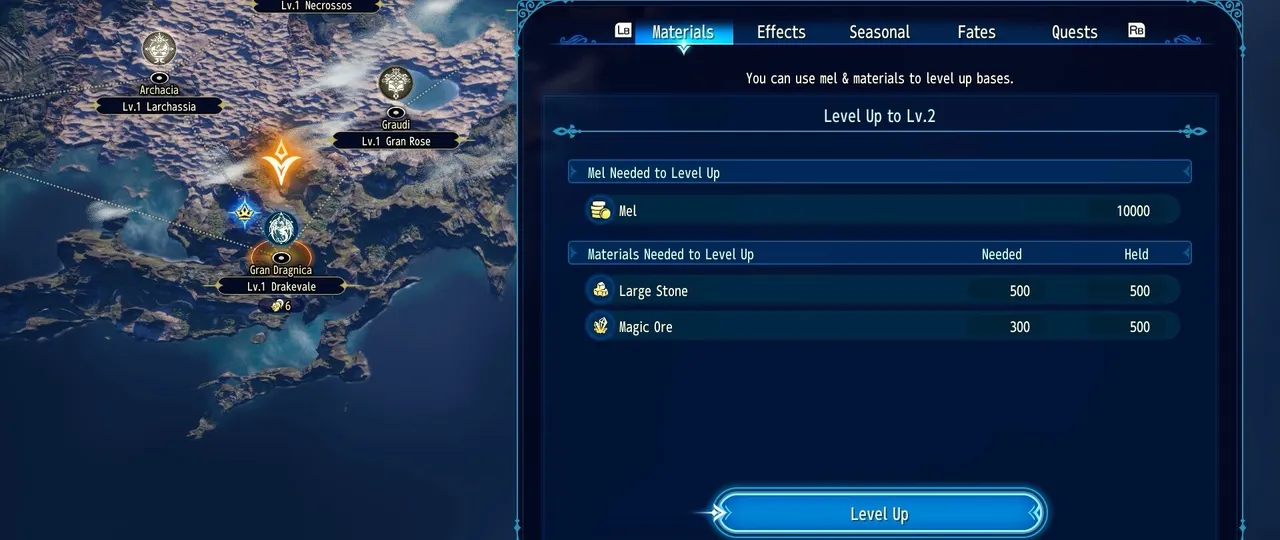
[IMAGE: Training Grounds or Exploration map screenshot]
Decision you face when a Leader or Monster is behind
Section titled “Decision you face when a Leader or Monster is behind”When a Leader or Monster is lower-level than your main force, you generally have three options:
- Keep the unit in reserve (idle)
- Pros: Keeps it available for immediate redeployments and retains formation control.
- Cons: Player reports suggest idle reserves can fall behind as enemies gain levels.
- Send the unit on Explorations (officially confirmed)
- Pros: The System page confirms Explorations provide resources, money, and EXP — a safe, official way to advance idle Leaders.
- Cons: The Leader will be unavailable for battles while exploring.
- Use quests (including the reported Training Grounds)
- Pros: Launch players report quests can grant materials, equipment, XP, and occasional recruitment; Training Grounds is reported to help weaker units level up.
- Cons: Quest outcomes, drop rates, durations, and exact EXP are not published here. The Training Grounds report is player-sourced and not an official table.
Practical guidance
Section titled “Practical guidance”- Keep battle-ready Leaders available. Don’t send every capable Leader away at once; you need at least a few to form squads and lead five-Monster teams.
- Use Explorations when you want a risk-free, officially described source of resources/money/EXP for Leaders who won’t be needed immediately.
- Use quests (including the reported Training Grounds) to target materials, equipment, or XP for specific reserve units, remembering that quest rewards and rates are player-reported and not guaranteed.
- Rotate reserves rather than leaving them permanently idle to reduce the risk of falling behind as opponents level up.
- If you’re aiming for class changes, remember the System page indicates class change may unlock at certain levels, but the game does not publish the specific requirements — plan progression with that uncertainty in mind.
Quick tips and links
Section titled “Quick tips and links”- Prioritize which Leaders must remain battle-ready for the next season or major battle, then send lower-priority Leaders on Explorations or quests.
- Use quests when you need materials or a chance at recruitment, but don’t rely on them for guaranteed leveling — player reports vary.
- For formation and squad planning, remember Leaders determine formation and squads can hold up to five Monsters; see the monster roster and class pages for unit roles: [/monster-list/], [/classes/], [/class-change-items/].
- For campaign planning, consult our [/walkthrough/] and season difficulty advice on [/difficulty-30-seasons/]. For upgrading strongholds and required materials, see [/stronghold-upgrades-materials/]. If you want battle preparation tips, see [/combat-tips/].
What we don’t know yet
Section titled “What we don’t know yet”- There is no official, published quest/reward table or guaranteed EXP values available from the System page. Exact quest success rates, durations, guaranteed drops, and recruitment chances remain unverified here.
- The Training Grounds and reported EXP season-scaling are player observations; verify in your own playthrough if you need precise numbers.
Bottom line
Section titled “Bottom line”Send idle Leaders to Explorations for officially confirmed resources, money, and EXP when you can afford to lose them for a time. Use quests (including the player-reported Training Grounds) to target XP or materials for weaker units, but keep enough Leaders on hand for battles and accept that class-change thresholds and exact quest rewards are not fully published. Rotate reserves to avoid the practical risk of falling behind.